Box Man and Nurse Reveal Themselves and Embrace
The Box ManThe encounter titled “Box Man and Nurse Reveal Themselves and Embrace” turns a promised meeting at the Hospital into a scene of exposed bodies and unstable identities. The Box Man Narrator arrives without clothes, still enclosed in his box, and is mistaken for the fake box man or fake doctor; once he leaves the box and approaches the nurse, he admits that he himself was a fake. The apparent recognition and intimacy therefore do not settle who is genuine. They bring the characters physically close while making the truth of their identities, and of the notes he carries, newly uncertain.
Arrival and Misrecognition
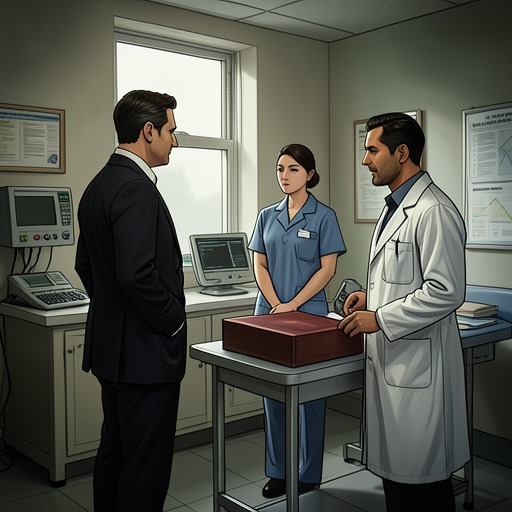
The Hospital door is locked, and a notice says that there are no examinations that day. The Box Man Narrator rings the bell impatiently, pressing it without letting up. When the door suddenly opens, the nurse hastily invites him inside and walks away, apparently grumbling because she takes him for the fake box man—or the fake doctor. He begins to explain himself before the mistaken identity can stand: he is not the doctor, he says, but the genuine article, the former photographer who had been waiting beneath the bridge the previous night.
The nurse scrutinizes him from head to toe, her lips parted and her expression vague with surprise. She says she is in a quandary and reminds him that he did not keep his promise, urging him to take off the box. His answer complicates the demand: he knows she is talking about the doctor, and he says he saw him in the street a little earlier. Their first exchange is thus not a simple reunion. Each seems to recognize a different problem—the nurse sees an unfulfilled promise and the doctor’s presence, while the narrator attempts to distinguish himself from the doctor and the false box man.
The Promise and the Naked Body
The narrator explains why he has not yet removed the box. He is stark naked: after seeing the nurse at the Hospital, he showered at a bathhouse and waited for his washed underclothes to dry. He meant to come to her after disposing of the box, so that he could show he kept his promise, but he fell asleep. When he woke, the underclothes and trousers he had hung out to dry had vanished. He recalls a possible dream near dawn in which children raced around with a flag fixed to a pole, then wonders whether the flag may actually have been his trousers. Faced with the missing clothes, he thinks he must find some trousers, but abandons that plan when he sees another box man near the end of the embankment and decides he has no time to spare before reaching the Hospital.
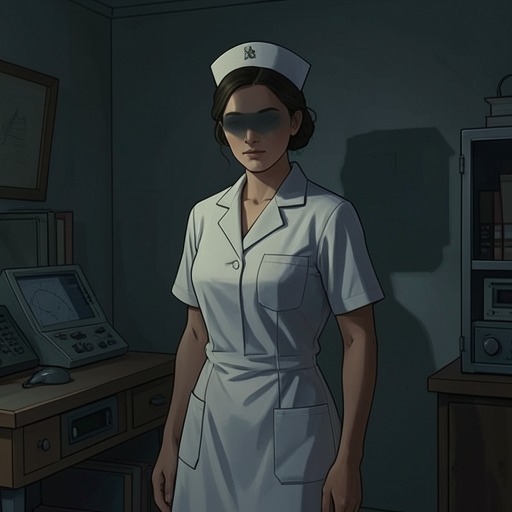
The nurse’s response changes the emotional register of the encounter. She first laughs in a way that feels unpleasant and jeering, but the sting passes; her laughter becomes amused, and her manner relaxes into cheerfulness and friendliness. She says the promise matters even if he is naked. When he asks to borrow trousers, she proposes undressing too, remarking that there is no need for shyness if both are naked. She then takes off her blouse, skirt, and brassiere, adding that she cannot stand the box another second. Her action answers his predicament without resolving it: instead of supplying clothes, she accepts the nakedness that prevents him from leaving the box as planned.
Leaving the Box and the Confession
Standing naked, the nurse appears teasing around the lips but carries a dark entreaty in her eyes. The narrator contrasts her ease with his own embarrassment, especially at the comical appearance of the lower half of his body peeking from the box. She tells him to close his eyes and turn away. With laughter in her voice, she faces the corridor wall. He removes his boots, feels his body shaking slightly, slips quietly out of the box, and approaches her from behind. He puts a hand on her shoulder; when she does not resist, he draws closer, telling himself that he must maintain that closeness forever. The movement out of the box is both literal and relational: his promise becomes an approach, and the nurse’s lack of resistance permits the embrace to begin.
At the point of greatest physical closeness, the narrator confesses that he was a fake. The nurse asks him not to say more. He then distinguishes his notes from his own false identity, claiming that the notes are genuine and that the real Box Man gave them to him to keep. The admission revises the encounter’s apparent recognition: the man who insisted on being the genuine article now acknowledges his fraud, while asserting an authentic connection to the absent Box Man through a written bequest. The nurse’s request for silence suspends rather than explains the contradiction.
The Notes and the Unsettled Truth
The narration itself warns against treating the notes as conclusive proof. It observes that writings left by the dead do not inevitably tell the truth: those about to die may carry jealousies and envies that survivors cannot comprehend, and some may answer the empty promises of truth with deliberate lies. The reader is cautioned not to accept the bait whole merely because the writing belongs to the dead. This qualification reaches back into the embrace, where a confession and a claim of inheritance seem to clarify identities only to destabilize them again.
The scene’s consequence is therefore intimate but not definitive. The narrator has left the box, and the nurse has met his nakedness with her own; his hand rests on her shoulder, and he resolves to preserve their closeness. Yet neither the promise nor the confession establishes an uncomplicated truth about who he is or what the notes mean. The encounter joins bodily exposure to narrative doubt: a box can be left behind for a moment, but the identities and testimony carried into the Hospital remain contested.